Pages

Search This Blog

Followers

Thursday, March 03, 2011

Feb 9 "Blues at the Crossroads" at Hill Auditorium


The expression "Blues at the CrossRoads" obviously has two separate meanings. This clever title for the event referred simultaneously, I suppose, to both the past and the present of the blues. On the one hand, given that the event was a tribute to the great delta bluesman Robert Johnson, the "crossroads" of the title was a reference to the celebrated mythology that has grown up around Johnson: that he is reputed to have met the devil at the crossroads and struck a bargain with him, dying early in exchange of acquiring the ability to play the guitar so prodigally in such a short period of time. (Here is Ann Arbor's own John Sinclair performing his poem "The Crossroads" about this legend -- although John Sinclair wasn't part of the HIll Auditorium event, blues and Ann Arbor cannot be mentioned in the same breath without thinking immediately of John Sinclair!) But "crossroads" also have another meaning; they represent possibility and choice, the ability to veer off into a new direction. A concert that gives itself over to celebrating "blues at the crossroads", then, signals through its very title that it is interested not so much in preserving the music as if it were frozen in time, as it is in being open to new directions and possibilities even as it pays homage to the past.


This dual celebration of old tradition and new possibility was well expressed in the roster of the event's musicians. On the one hand, there were the canonical bluesmen, grand old men of the tradition, its legends: the 95-year-old David "Honeyboy" Edwards and the 79-year-old Hubert Sumlin. On the other hand, there were also Todd Mohr (of Big Head Todd and the Monsters), the guitarist Steve "Lightnin' " Malcolm and the drummer Cedric Burnside, the grandson of the great Mississippi bluesman R.L. Burnside. While several blues standards associated with Robert Johnson -- such as (of course) Crossroads Blues, were interpreted by the evening's performers, and such blues standards as Johnson's "Sweet Home Chicago" were sung, there was also ample room, especially by the likes of Todd Mohr and his bandmates Squires, Nevin and Lawton, for a more contemporary, experimental, rock-music-inspired blues sound as well. (Interestingly, the review of the event by annarbor.com is scathingly critical of this aspect of the concert, opining that the insertion of a more contemporary sound into the event represented a lack of authenticity. I disagree -- I think it is much more interesting to "mix it up" as the event did, to have the old and the new sound share the stage and rub shoulders, so to speak.)


Tuesday, February 08, 2011

Laurie Anderson's _Delusion_


When Laurie Anderson talked to a large and expectant audience at the Michigan Theater on Thursday January 13, before her performance at the Power Center the following weekend, it must have clear to everyone present how original she was in her thinking --- and how the promise of that originality of thought is translated into her out-of-the-box performances. Two of the things that she said in course of her talk at the Michigan Theater especially struck me.


The first concerned scale: she said that while
digital art (like the multimedia performances she has become famous for) is increasingly more convenient to create using computers, what this kind of work lacks is a sense of scale. Mentioning that she started her artistic career as a sculptor, she said that that early training had ingrained in her a respect for scale, because sculptors work directly with physical material in three dimensions. What she is trying to do with her multimedia performances now, she said, was to attempt to introduce a sense of scale. Perhaps one way of thinking about this is that she is trying to mingle reality with virtuality.

The second comment made by Anderson at her Michigan Theater talk that struck me had to do with her statement that she was tired of the production of more and more conventional artifacts in the name of art. This, one suspects, has probably made her turn to multimedia performances, for performances are not artifacts: rather than commodities, they exist ethereally, only in performance. Her impatience with conventional artifacts found yet more expression in her talk when she decried how used we have gotten to staring at rectangular screens all day: the computer screen, the television screen, and even the screen on which a film is projected, are all variations of the same boring rectangle, after all. That she is trying to get beyond this is apparent in Delusion, in which there are at least three oddly shaped "screens" onto which images are projected: a crumpled-looking screen, another which is non-rectangular, and even, oddly enough, a curiously undefinable object that looks somewhat like a love seat, on which, in fact, Anderson appeared to sit during parts of the performance.

If parts of Delusion, with its often surrealistic imagery, stream-of-consciousness narrative, and
Anderson's adoption, from time to time, of the baritone voice of her male alter ego, Fenway Bergamot, might have seemed bewildering and disjointed to the audience at times, it perhaps helps to think of the performance, as Jenn McKee writes in annarbor.com, as "a collection of some of Anderson’s most vivid dreams." Some comments by Anderson about the show, which were published in the Metro Times a few days before the Ann Arbor performance, are also quite insightful in trying to grasp what she was trying to do in the show, and why.


Wednesday, January 12, 2011

TED Talks Music!

If you've never heard of the TED talks, go to Google and check them out. You can find a short, intellectual discussion on nearly any topic imaginable, and I promise you will leave feeling enriched or at the very least entertained.

Some fellow bloggers just posted this list of 20 Incredible TED talks for Both Music Students and Lovers alike*.

Click on the link you can listen to talks by musical superstars (Eric Whitacre and Bobby McFerrin both have their own piece), well-respected musical therapists, and multicultural artists.

Enjoy!

Sarah Bichsel
UMS Student Committee President

*Special thanks to Florine Church and company for the link*

Wednesday, December 29, 2010

Handel’s Messiah


Something really special about this year's performance of this long-standing Ann Arbor tradition, Handel's Messiah by the UMS choral union, was that the principals of the event all shared a strong connection with Michigan. Three of the four soloists (Caitlin Lynch, Nicholas Phan, and Jesse Blumberg) were actually UM alums., while the fourth, Meredith Arwady, was also a Michigan native -- a resident of Kalamazoo. Two UM music professors were also prominently featured: Edward Parmentiari on the harpsichord, and Jerry Blackstone, conductor and music director.

Handel's Messiah has a tripartite structure. Concerned as it is with the story of the "messiah", that is, Christ, Its three sections correspond to "the prophecy", "the passion" and "the resurrection", with the most intense part of the piece consisting of the "Hallelujah" section just before Part II. Traditionally the audience joins in the chorus during the singing of this "Hallelujah" section, and that was the case, too, in this performance. In fact, the University Musical Society actually made the music available to audience members to sing to. The text (oratorio) of Handel's Messiah is actually drawn from various verses of the Bible. The "Hallelujah" sections, for example, are taken from Revelation 19: 6, Revelation 11: 15 and Revelation 19: 16. (By the way, the British Library has made the original score to Messiah, in Handel's own handwriting, available on the Web.)

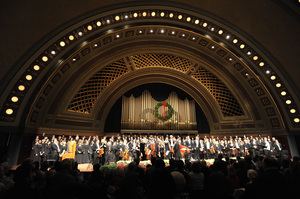
The stage of the Hill Auditorium was beautifully decorated, with a mass of white poinsettias near the front of the stage and a large wreath hanging from the cavernous ceiling. The red color of the harpsichord was a nice touch.

In performing a work like Handel's Messiah, the elements of the dramatic in the work have to be carefully balanced against the element that expresses piety. This performance, overall, managed to do that well.

Friday, October 29, 2010

"Sankai Juku" last Sunday, Oct 24

I had attended Sankai Juku's last performance in Ann Arbor back in 1999, and, ever since then, I had been enthralled by the dance form of butoh, of which Sankai Juku is a proponent. Last Wednesday, I went to attend the film screening at the University of Michigan Museum of Art, in which two films about butoh, both of them dating from the 1960s or 1970s, were screened. (You can see excerpts from one of the two films, Dance of Darkness, online). So, I walked into the Power Center on Sunday with some familiarity with butoh asw well as some expectations about what the performance was going to be like.

My expectations were both confirmed and belied in interesting ways. The performance that I had seen in 1999 had been much less lyrical and much more minimalist -- and, in that sense, with much more in common with butoh's early years of 1960s-1970s. That performance, with its slow writhing gestures and guttural cries that seemed to approximate cries of pain, had put me in mind of what the philosopher Giorgio Agamben has called "bare life". Christina Mcfee writes about this notion in a powerful passage:

'Bare LIfe' -- A Lyrical and Even Ecstatic Dimension

What is "bare life"?

This question underscores the sheer vulnerability and complete exposure of being.

Bare life deals with that part of our existence from which no measure of security will ever protect us. It is the part of life that is absolutely exposed.

But as in sexuality, absolute exposure is intricately connected with infinite pleasure. There is an apocalyptic and obviously political dimension to bare life (brought out by torture and the concentration camp). There is, however, also a lyrical or even ecstatic dimension to freedom of bare life for new and unexpected possibilities (in human relations as well as in our relationship to nature or, more generally, to the world in which we live).

Butoh as a dance form is, I think, expressive of this "sheer vulnerability and complete exposure of being". Clad in minimal, raglike dresses and with a layer of white chalk-like paint covering their entire bodies, butoh performers tend to look anonymous on stage, with all indications of individuality stripped away: life at its most elemental. The philosopher Baruch Spinoza remarked (in 1677, in his book Ethics) that "we (still) do not know what the human body is capable of, nor the limits of what it can do." Thinking of butoh makes me think of that remark, because the practitioners of butoh, with their slow, mindful movements, and their emphasis on the physicality of the body and the mystery of its existence, seem to be exploring the outer limits of the possibilities of the movement of the human body.

Sankai Juku's performance both reinforced this ethos of butoh and simultaneously went against its grain. Titled "Hibiki: Resonance from Far Away" -- you can view UMS's program booklet about the event here -- this dance performance was uncharacteristically "pretty" (in a conventional sense) than one tends to expect in a butoh performance. (Jann Parry, writing in The Guardian newspaper of the U.K., has called 'Hibiki' "designer Butoh for new-age audiences," accusing it of having "little in common with the Japanese 'dance of darkness' that developed after the Second World War," and stating that "Sankai Juku have become the style queens of the Butoh performance circuit." So,well... is this diatribe justified? Have Sankai Juku really sold out, or sold their soul, in order to become a crowd-pleaser, betraying the uncompromising attitude of butoh as originally formed in the countercultural cauldron of 1960s Japan?

I think that the answer is both yes and no. The Guardian's reviewer does make a good point in pointing out that 'Hibiki' is too prettified, too mainstream. (But then, had Sankai Juku not acquired some degree of mainstream status, would the UMS even have brought it to Ann Arbor? Or afforded to? Organizations like the UMS do have to depend on ticket sales, and hence on audience tastes.) That aside, I do not think that the bareness and minimalism of butoh as it originally arose was necessarily missing from the 'Hibiki' performance. It was still there, with other layers and other influences having been overlaid on it and enmeshed with it. This was very apparent, I thought, in particular in a sequence within the performance in which the four or five performers would crouch very close to the ground, in almost a fetal position, and then abruptly rise up, draw themselves to their full height, and raise both hands upwards as if reaching for the sky, only to lie down again and crouch. Arguably, both the bareness that is elemental to butoh and the almost balletic, conventionally beautiful, lyricism of more conventional dance forms were present in that gesture. The two complemented each other, and together they managed to suggest, I thought, the complexity of man's being in the world: caught between animality and godlikeness, always pulled groundward by gravity but also always aspiring towards the sky in leaping exaltation. Man is, the performance seemed to say, a liminal creature caught forever between a nether world of despairing animality and an outer world of exquisite sublimity that always remains just beyond our grasp.

So too with the vase-like objects up near the proscenium's upper reaches, dripping a blood-red liquid in slow, spaced-out drops at a time, collected in a huge circular bowl around which the performers stood. From one point of view, it could be thought painfully kitschy, and perhaps it was. But it spite of coming in arguably New Age accouterments, it also reminded me of the fierce beauty of a famous passage from Aeschylus' Agamemnon:

And even in our sleep
pain that cannot forget
falls drop by drop upon the heart,
and in our own despite,
against our will,
comes wisdom to us


(Agamemnon, 179-183)

Perhaps this is all part of what Sankai Juku meant by the phrase "resonance from far away" in the title of the performance: not just elementality but resonance, with all human experience -- which perforce must include not only the strange and the unconventionally beautiful, but also the conventionally beautiful; for that, too, is part of human experience.

Sunday, April 11, 2010

Danilo Pérez and Baaba Maal (on different days)

I'm going to combine my comments on the concert by Danilo Pérez and his ensemble, from Thursday, and the performance by Baaba Maal and his troupe, from Saturday, into this one and the same blog post.

While, during the first century of its existence, the University Musical Society almost exclusively hosted concerts of classically oriented Western music, in the last two decades it has been sponsoring more and more events with an increasing international flavor. In part, this is probably in recognition of the fact that UMS's audience, much like the demographics of the country as a whole, has grown more cosmopolitan and diverse, and continues to become more so. The concerts by the Panama-born Danilo Pérez whose group plays jazz with an international orientation and the Senegalese musician Baaba Maal, who plays West African music of an Afro- pop orientation that builds on traditional African music but is also inflected with Congolese, Afro-Latin and blues influences, illustrated this cosmopolitan trend that the UMS has been following.

First, the Danilo Pérez concert. Unfortunately, I had left my hearing aids at home (I remembered them only when I got on the bus for the concert and by then it was too late to go back and get them) and so I was somewhat handicapped as I was not hearing very well. Fortunately, the Hill Auditorium acoustics are very good, and the performers were all miked (a controversial issue, if you check out the posts at umslobby.org -- but which worked well for my situation).

I had been very curious to see Rudresh Mahanthappa, the saxophonist with Danilo Pérez, as he has been making big waves recently, especially in his ensemble work with Vijay Iyer. (Iyer and Mahanthappa will be playing together next Fall under UMS's auspices). Being as I am from India myself, I was especially curious to hear Mahanthappa play, as I had read that he brings Indian classical music, especially Carnatic music, influences to his playing. Actually, during one piece during Thursday's performance, Mahanthappa's saxophone seemed to provide the organizing principle and it definitely seemed inspired by a Indian classical musical sensibility.

I had been a little less enthusiastic about how the concert had been billed by UMS as "Twenty-first century Dizzy". That made the concert seem derivative: while Dizzy Gillespie was a great musician, jazz is ever-changing and forward-looking; so, to confine a musical description to the constraints of a "big name" from the past seemed somewhat like a marketing gimmick and also unfair to the musicians. Danilo Pérez is a superb musician in his own right, and to associate Dizzy's name with the concert in the way it was marketed seemed to me a trifle odd. In any case, Danilo Pérez played very well, and so did the other musicians, who all have very varied backgrounds.

I would suggest to UMS, though, that the Power Center (or even the Michigan Theater) might have been a better venue for jazz concerts of this kind than the Hill Auditorium. First of all, all too many seats remained empty at the capacious Hill for this concert, making the musical energy seemingly dissipate somewhat, whereas, in a venue like the Power Center or the Michigan Theater, the same size of audience packed into the smaller space of those venues would likely have contributed to a much more contagious and electric musical energy of the kind that feeds off a full crowd.

Finally, I have to report a problem that really drives me up the wall: too many people seemed to be checking their ipods or phones during the concert. Although the UMS is meticulous about asking people to turn off their cellphone ringers, maybe it should also ask people to desist from checking emails or otherwise using their phones or ipods during concerts, as the backlit blue screens of these devices happen to be very distracting to the people sitting in the row behind the people using them. Are people's attention spans so short these days that they cannot even last a concert's span without feeling compelled to check their email?

Next, let's talk about the Baaaba Maal concert of last Saturday. After Nomo, the African-music-inspired world music fusion band originating from Ann Arbor opened for them with a solid performance, Baaaba Maal and his entourage of Senegalese musicians, each wearing a flowing African robe of a different color, took the stage. The ever-smiling Baaba Mal, with his serene and melifluous voice, singing and speaking inspiring music and words calling for African unity and advancement, was a regal presence, and the audience participation was overwhelming. It seemed that a large body of the West African disapora in the South-Eastern Michigan area had turned up for the concert, many of them dressed in traditional costume, and kept climbing up on to the stage to dance energetically at every opportunity that presented itself. During the concert, Baaba Mal sang mostly in an African language that, I believe, was probably the Pulaar language. (The one song that I recognized was his song "Television" from his recent album. In course of the concert he introduced Mansour Seck, his bandmate, a blind Senegalese musician who has been a friend and influence on him since his earliest days as a musician, and who provided the backing vocals at this concert. The very tall Momadou Sarr, playing percussion both western and traditional, and Massambla Diop playing the talking drum, were also bundles of coiled musical energy.


Wednesday, March 31, 2010

On Chekov and Translating: Maly Drama Theatre of St. Petersberg’s Uncle Vanya

Uncle Vanya is a play that drives literary critics crazy: there is no main character, there is little plot and many of the monologues make little sense. The play centers on the aged Professor Serebriakov (who isn’t the main character) and his relatives, who spend their time on the Professor’s country estate having rather complicated relations with each other and going through a “midlife crisis.” A realistically bittersweet portrayal of regrets about opportunities missed and lives wasted, it is also a play about the search to create a new life, one that will exist a hundred or two hundred years from now, when people will know how to be happy. And the fact that nothing happens except reminiscences, conversations, and attempts to find too late the happiness that slipped through one’s fingers – that is Chekov’s way of making his point. As the play goes on, the audience too feels the dull reality of the characters, and understands the madness of their desires. It is poignant – and yet heartbreaking – to watch the madness of people who have missed their chances or who (like Sonya, suffering from unrequited love) see their chances slip through their fingers and their dreams break.

The audience, however, seemed to find the Maly Drama Theatre’s performance of this “tragicomic masterpiece,” as it has been called, funnier that it was intended to be. A tragicomedy is something between a comedy (which means not that it’s supposed to be funny, but that everything will end “happily”) and a tragedy (where everything does not end “happily,” such as in the story of Oedipus). In short, it is a play whose ending is neither “happy” nor tragic, and that is not intended to be funny. There is nothing inherently amusing about Uncle Vanya trying to make up for the opportunity he missed years ago by courting Elena, for example, or in Sonya’s sometimes unreasoned actions due to love. Yet the audience laughed.

Perhaps the audience’s misinterpretation of the play was due in part to the overtitles; Russian being my first language, I was lucky enough to be able to understand the play in the original, however, I occasionally followed the translation - enough to realize both its inexactness and the difficulty of translating this play. A viewer will obviously not have time to ponder the nuances of a particular word or phrase as the play is going on, yet I found the overtitles inexact to the extent that they were misleading. Phrases were left out, the song sung by Doctor Astrov was completely different than the text in the overtitles…and the significance of some key phrases was lost. The Professor’s phrase about the necessity of “doing the deed,” for example, was not a sexual reference, but an ironic statement by somebody who has spent his life reading and writing to the hardworking people around him that they have been doing nothing and that they must start doing work; Elena’s response to Uncle Vanya’s vows of love, translated as “Your love…it makes me numb,” suggests in the original that Elena could be becoming blunt, numb, or stupid, and the emphasis seems to be on the idea that his vows of love make her unresponsive, blunt, withdrawn – she simply does not care, and his vows do not move her. These nuances are difficult to convey in a written translation, and even more so in overtitles, but I found myself disappointed that a greater attempt was not made to capture the essence of Chekov’s meaning.

In the end, however, the words were no more powerful than the lack of them. The agony, anguish and despair of the characters (so brilliantly portrayed by this troupe of actors) and the tense moments of silence (possibly the director Lev Dodin’s addition) were as full of feeling as the powerful speeches, and required no translation to convey the pain of people who are searching for a way to make the world happy one day, even though their dreams of happiness were thwarted and their hopes melted into mist.

By: Ana Klimchyskaya
UMSSC Member

Monday, March 29, 2010

Uncle Vanya

A performance of Chekhov's Uncle Vanya by the Maly Theater of St. Petersburg


written by a member of the University Musical Society Student Advisory Committee

As I was walking into the Power Center, I saw my housemate Ilya, a UM graduate student who is originally from Estonia and speaks Russian fluently, buying a ticket at the box office. Ilya wised me on to the fact that the Maly Theater of St. Petersburg is considered to be the premier interpreter of Chekhov in the world. I had an idea that they were famous, but I didn't know that they were that famous.

So, it was with expectations raised sky-high that I walked into the auditorium. (Incidentally, when I had picked up my tickets from the Mendelssohn Theater box office, the nice people at the desk had handed me a leaflet that said that, at the request of the Maly Theater, the production was supposed to begin exactly at the listed time and that everyone should be in their seats accordingly. I had been so intimidated by this injunction that I made sure to take my seat before the hour of 8:00 pm struck -- but the play, strangely, did seem to start at Michigan time after all. In any case...)

The first thing to notice about this production was that the production was much longer than I expected. Uncle Vanya is a very short play -- on the printed page, that is. I expected it to be over very quickly, but the Maly Theater had found out, it seemed, a way to wring duration out of Chekhov's habitual brevity of style.

In psychobabble-speak, one could describe Uncle Vanya, perhaps, as a play about mid-life crises. At the age of forty-seven, Vanya wakes up to the reality that he has been a failure and that none of the dreams he had as a youth have come to fruition. The melancholy note of the play derives from Vanya's realization that he had dedicated his life to selflessly serving a man (the self-important and narcissistic professor Serebryakov) who feels nothing but callous disregard for him. Vanya is a tragicomic figure -- we both laugh at him and feel pity and terror at his fate, knowing in our hearts that Vanya's destiny is, after all, a common human condition that could well befall ourselves, too, in one way or the other.

It is this sense of tragicomedy that is very difficult to pull off successfully, and in doing which the Maly Theater succeeded quite well. The tragicomedy demands quicksilver transitions of mood, as the play seems constantly to turn on a dime between sly humor and high tragedy. Avoiding the twin pitfalls of the banality of cheap laughter and the mushiness of shallow sentimentalism, the Maly Theater production guided the audience with a firm hand through these mood swings almost like a matador leads the bull this way and that with nothing but minute movements of the cape, so that the audience kept snickering and guffawing at one moment and falling into a stunned and awe-struck silence at the end. And at the amazing conclusion of the play -- Sonya's heroic attempt to wrest dignity and meaning out of the slings and arrows of outrageous fortune that flesh is heir to, her impassioned, piercing and repeated cry of "Mi otdokhnyom" ("We will rest"), I had tears flowing down my cheeks.

Vladimir Nabokov (whom I always find very insightful on the topic of Russian literature) had this to say about his fellow country-man Chekhov, which describes chartacters like Astrov and Vanya in the play to a "t":


"[...]It is not quite exact to say that Chekhov dealt in charming and ineffectual people. It is a little more true to say that his men and women are charming because they are ineffectual.

"But what really attracted the Russian reader was that in Chekhov's heroes he recognized the type of the Russian intellectual, the Russian idealist, a queer and pathetic creature that is little known abroad [...] Chekhov's intellectual was a man who combined the deepest human decency of which man is capable with an almost ridiculous inability to put his ideals and principles into action; a man devoted to moral beauty, the welfare of his people, the welfare of the universe, but unable in his private life to do anything useful; frittering away his provincial existence in a haze of utopian dreams; knowing exactly what is good, what is worthwhile living for, but at the same time sinking lower and lower in the mud of a humdrum existence, unhappy in love, hopelessly inefficient in everything—a good man who cannot make good. This is the character that passes—in the guise of a doctor, a student, a village teacher, many other professional people—all through Chekhov's stories ..."


I find Nabokov's emphasis in this passage on the Russian-ness of Chekhov interesting, in the light of how the Maly Theater succeeded in transcending the language barrier (the surtitles helped, of course, but they are never the whole thing) in communicating the essence of the play to a largely non-Russian-speaking audience.


Sunday, March 14, 2010

"Beat the Donkey" with Cyro Baptista


A performance by Beat the Donkey (Cyro Baptista and other musicians)


written by a member of the University Musical Society Student Advisory Committee

A few years ago I had the opportunity to listen to David Barsamian interview University of Colorado ethnomusicology professor John Galm about Brazilian popular music. In that interview, Professor Galm said something that I was reminded of by Cyro Baptista and Beat the Donkey's performance this past Saturday. Galm remarked in the interview that Brazilian popular music, in particular the music of the carnival, rests on a tremendous inventiveness. Since musical instruments can be expensive and often beyond the reach of common people, the masses in Brazil often simply improvise, Galm said, making music out of whatever is at hand. This has given rise, Galm said, to a quite wide variety of quite unorthodox and wildly inventive instruments, some of them even improvised from domestic utensils or appliances such as pots and pans, shelves or wooden crates. It is a matter of making a virtue out of necessity, so to speak.

In its performance, Beat the Donkey led by Cyro Baptista seemed to have taken this Brazilian tradition into a flight of whimsy that seemed to make the show part vaudeville, part a world music pageant, and part a fanciful caper. Over there in the [art]seen blog, Krithika has already done an excellent job of describing the concert, and so I won't give you a blow-by-blow account. Rather, I will be somewhat impressionistic and simply share my general thoughts about the concert.

Cyro Baptista reminded me somewhat of the great Brazilian multi-instrumentalist Tom
Zé, well-known for creating music with the sounds of blenders, floor polishers, radios, typewriters and vacuum cleaners during the 1970s. Zé (and to a lesser extent, Zé's fellow artists in the Brazilian "Tropicalia" movement, too) were harkening back to the Brazilian writer Oswald de Andrade's influential "Cannibalist Manifesto" of 1928, a key text of Brazilian modernism, in which Andrade had compared the postcolonial re-appropriation, in places such as Brazil, of European/North American cultural symbols, to "cannibalism". The idea is that we postcolonials cannibalize (literally consume) western cultural artifacts, and in doing so we create something new out of them, very different from their originally intended use. The appearance, at one point in Beat the Donkey's performance, of a giant Coca-Cola crate (used as a percussion instrument) is a gesture, i think, towards this "cultural re-appropriation."

After the performance, I had a very lively and interesting discussion with a friend over coffee at Panera's. She said -- and I think she is correct -- that a concert like this can all too easily become kitschy, an exercise in mere showmanship and crowd-pleasing -- and in pandering, with its profligate and over-stumulative excess -- to us, the perpetually attention-deficient denizens of the cyberculture era, who are likely to lap up such pageantry and consume with goggle-eyed ecstasy, the globetrotting bricolage of world-music samples seemingly thrown together in a randomly jumbled, decontextualized, fashion. But I think that Cyro Baptista is well aware of this, and, with more than a hint of self-parody, he is putting on this performance in what is actually an ironic way. Very postmodern, in fact. He is, I think, while not denying the cacophony and kitschiness of modern existence, challenging its meaninglessness and actually humanizing it by performing it with fellow musicians with such joy and intensity.

In fact, something that Cyro Baptista says in one of his interviews is very revealing, I think, of how he envisages this kind of performance as, in a small way, an act of resistance:

Interviewer: Music brings together people in harmony…

Cyro Baptista: Yes. When I started to get together ‘Beat the Donkey’ I had this idea and I call this percussionist and I say, ‘I want to have music and dancers all together and do this….’ And he says, ‘Man. Why do we need ten people to do that? Me and you, we can do this with machines…’ In a time like we are passing now we need to do things together …… to see if we can transform the energy…. I wake up now and I see this stupid man who wants to have a stupid war and I think ‘What the f*ck…Why?’ This guy is wasting his time…I barely have time to do things during the day like composing, doing this and that, taking care of the kids, and how does this guy have time during the day to make a war? Does he not have anything else to do?


Wednesday, February 24, 2010

Bela Fleck and umsLOBBY

Last Wednesday was quite a night to remember, as Bela Fleck brought the sound of Africa to Ann Arbor with his Africa Project, in which he traced the roots of the banjo. He brought different groups from Africa, each representing a form of music or playing musical instruments that influenced the creation of the banjo.

I was working and thus stepped into Hill after the concert had begun. Upon entering, I heard the virtuosic sound of Anania Ngoliga playing the ilimba, which is a type of thumb piano. I didn't realize until he was walking off stage, that he was blind! A friend of mine later referred to as "the Ray Charles of thumb piano," a great description!
Anania Ngoliga with his ilimba

After Ngoliga's performance, we switched gears as Bassekou Kouyate, one of the masters of ngoni, stepped on stage. Kouyate and his band, many of whom are family members, played all 4 types of the ngoni, which is a stringed banjo or guitar like instrument. At the Arts and Eats event prior to the performance, the guest speaker compared the ngoni to the saxophone family, with an alto, tenor and bass.

The several different sizes of ngoni

Kouyate played "the soprano" version, as he led the group like a rock star, with his leg rested the amp, strumming virtuosic melodies even Zeppelin would be jealous of. The atmosphere of Hill during the performance was much more like that of a rock concert than of a classic world music concert, with high energy and lots of laughs.

Bassekou Kouyate with Bela Fleck

The rest of the concert consisted of a blending of the many different styles of music we heard that night. An impressive and once in a lifetime kind of show.

But the performance wasn't the only thing UMS had going on that night. It was also the kickoff event to our new website, umsLOBBY.org, which takes the best parts of Facebook, Twitter, YouTube and Blogs and brings them together to create a social media hub all about the art and culture of UMS. And the whole idea is simply to get people to talk. In addition to the online portion of umsLOBBY, we will have events like the one at Bela Fleck, where we simply want to get people to talk about what they are experiencing.

If you were at the concert, you may have seen the walking highlighters, decked out in green and orange, all of whom were all members of UMS staff team. As one of those highlighters, I wandered the crowds chatting with people about what brought them to the concert, their expectations and their experience. When talking to one group of students, they told me they only came because their friend had tickets and couldn't use them, so they were free and had no idea what to expect. Another group of students overheard them say that, so jumped into our conversation and told them all about Bela Fleck and the Africa Project. A much more knowledgeable bunch than I, I simply listened and learned. That experience was the epitome of umsLOBBY, turning this performance into a social experience as well as a cultural one and into one heck of a Wednesday night.

Monday, February 15, 2010

Luciana Souza with Romero Lubambo and Cyro Baptista


A performance by Luciana Souza with Romero Lubambo and Cyro Baptista


written by a member of the University Musical Society Student Advisory Committee

In 2002, the New York Times described Luciana Souza as "omnicultural". In her interview with Terry Teachout, Souza said, "People say, 'Oh, you're so eclectic,' and I usually say that I really don't look at styles anymore... I recognize, well, it's classical music or contemporary this or jazz that, or Brazilian, but I'm not worried about that... Let people decide for themselves what I am, and if they don't like it, they can get their refund on the way out.'' Teaming up with guitarist Romero Lubambo (who was already in Ann Arbor last Fall, performing with Gal Costa) and percussionist Cyro Baptista, Souza gave exactly this kind of easygoing and eclectic performance.

While some, such as the critic John Kelman, have characterized her singing style as "new bossa nova", Souza also regaled the audience with a few old and classic bossa nova standards. The ones that I think I recognized (although I am not completely sure) were Dindi and Águas de Março ("Waters of March"). Mostly, however, she engaged in a delectable and playful musical conversation with Lubambo and Baptista.

A description of the evening will not be complete without a few special words about Baptista, whom Relix Magazine has described as possessed of an "unbridled imagination, intense musical knowledge, skill and lust for sheer joy". Playing instruments that belong to the traditional drum set, as well as what looked to be traditional Brazilian percussion instruments (including gourds), and in addition playing bizarre-looking instruments that seemed to have stepped out of the imaginarium of a febrile musical genius, Baptista engaged in some intense percussion, smiling and thrusting his salt-and-pepper beard to and fro, looking somewhat like a mad scientist let loose in a music-maker's workshop.


Sunday, February 07, 2010

The Bad Plus


A jazz performance by The Bad Plus


written by a member of the University Musical Society Student Advisory Committee

Before attending the actual concert this past Friday, I went to the UMS educational event, "Music of The Bad Plus", which was held on Tuesday, February 2 at the UMMA Commons. In this educational event, UM jazz professor Andrew Bishop gave a presentation on The Bad Plus' music. He explained that what the group performs is an interesting synthesis of three distinct genres, whose distinctions they like to blur: jazz (of course), and popular music, and (more unexpectedly) European art music. Several UM Music School students were on hand to punctuate Prof. Bishop and his collaborators' talk with live musical demonstrations.

The Bad Plus actually presented two separate concerts on Friday February 5, both at the Lydia Mendelssohn Theater in the Michigan League. I attended the second of the two concerts. From friends who had attended the first concert, I heard that they had played arrangements of pop songs (something which they are famous for) in that concert, while in the later (9:30 pm) concert, which I attended, they played mostly their own compositions.

In his book The Jazz Book: From Ragtime to Fusion and Beyond,
the critic Joachim-Ernst Berendt writes that piano trios tend to come in two different flavors. Some piano trios are what Berendt calls "conversational" trios: the musical model in such a piano trio is that of a musical dialogue between the pianist, percussionist and bass player, with each taking turns to solo and respond to the other two. The other model of the piano trio is what Berendt calls the "power" trio, in which the three musicians are more invested in playing music simultaneously, creating a convergence of sound, rather than in taking turns solo-ing. The Bad Plus proved to be solidly in the "power trio" tradition, with its three musicians -- Ethan Iverson on piano, Reid Anderson on bass and Dave King on drums -- playing mostly together and feeding off each other's musical energy. It was a measure of how enthused the audience was by the musical fireworks, that it stood on its feet applauding rapturously with such intensity that The Bad Plus returned on stage to give not just one but multiple encores.

Finally, I have a suggestion for UMS. I think that the decision to have this performance at the
Lydia Mendelssohn Theater was an excellent one. The Mendelssohn Theater is ideally suited for intimate and edgy performances of this nature -- just as it was for the UMS performance by another edgy, avant-garde band, eighth blackbird, a couple of years ago. (I had written about that performance, too.) However, I think that the location of the University Museum of Art Commons for the educational events associated with the performance is not a good choice. This is the second UMS educational event at the UMMA Commons that I went to -- the other one was in connection with the Bill T. Jones performance -- and I had the same thoughts on both occasions. Firstly, the UMMA Commons space is too small. On both the two UMS educational/pre-performance events that I attended there, there were more people than the space could accommodate. If you must have the educational events there, perhaps you could at least get rid of the tables among the audience in the room, which just take up space and perform no useful function during the pre-performance event. Without the tables, you could accommodate more people in the room. Also, the chairs in the UMMA Commons make too much noise every time someone drags them -- it is very distracting. It would be nice to have the educational/pre-performance events at a less noisy space.

Monday, February 01, 2010

Ladysmith Black Mambazo

After 50 years of singing, Ladysmith Black Mambazo has lost none of what made them so famous to begin with. While I'm don't feel particularly enlightened about South African culture, I did enjoy myself immensely. These men have rich voices and create beautiful harmonies that carry you right into the music.


For the duration of the concert I felt as if I was part of the rhythm and part of their family. Their dancing did not feel choreographed, but like a physical manifestation of their sheer pleasure of being. Their songs were inviting and joyful, and whether the song was about hope or homelessness, the theme of togetherness remained a constant. I left the concert revitalized and content with the world.

By: Molly Baumkel
UMS Student Advisory Committee Member

Friday, January 29, 2010

The Humble Conductor

An all 20th Century program: Ravel based on Couperin, a modern Flute Concerto, and a opera in concert... by Bartok? Quite a hard sell and yet there were people asking me about getting Rush Tickets up until an hour before the show! As much as I would like to think that it was my amazing marketing talent, unfortunately I know that is not the case. Whether it was because of or in spite of the program for this past Wednesday's performance, most people came out to see Pierre Boulez conduct in Hill Auditorium once again.


Boulez's subtle conducting, although not incredibly entertaining as my friend whose Rush Tickets landed him in the front row made sure to let me know, carried an energy and passion that led these incredible musicians to several standing ovations. During the long and well-deserved applause, I was struck by how humble Boulez was; always motioning for his soloists to take the front of the stage, leaving himself slightly in back. The conductor of my non-music major, unprofessional choir will take 10 bows for himself before motioning to us. But not Boulez. In the diva/divo centered world of music, it was refreshing to see such a great musician, who didn't need that limelight.

By: Rachel Lum
UMS Student Marketing Intern

Monday, January 25, 2010

Arts and Eats: Bill T. Jones/Arnie Zane Dance Company

The UMS Paparazzi were out once again last Friday night at the Arts and Eats event in the UM Alumni Center.

As students entered, they were greeted by the lovely face of UMS Student Advisory Committee Members, Sarah Bichsel (left) and Lena Cintron (right).


After picking from a wide variety of pizzas, students headed to the drink station to quench their thirst.

Then students enjoyed their meals, chatting about the exciting show they were about to see.

Students got to enjoy a talk by Janet Wong, the Assistant Artistic Director of the Bill T. Jones/Arnie Zane Dance Company. Janet discussed the artistic process and how the company worked together to develop "Fondly Do We Hope... Fervently Do We Pray." She mentioned a type of improvisation the company used, which involved moving together in an ovular pattern, hence the use of ovals on the stage! She gave an incredibly interesting perspective!

After Janet's talk, students hung out at the Alumni center and enjoyed each other's company while waiting for the show.


Some brought homework...

... some did each other's hair...


... and some even brought art of their own to do!

Overall, it was a great night! If you want to come join the fun, then check out the UMS website for more information about tickets, which go on sale about two weeks before the Arts and Eats performance. We still have Arts and Eats events for:

The folk musician, Bela Fleck's Africa Project, in which he explores the roots of the Banjo on Wednesday, February 17 at 6:30 in the Hill Mezzanine Lobby

The incredible Takacs Quartet, who will be performing two Beethoven quartets along with a new work, on Monday, March 15 at 6:30 in the UM Alumni Center

A program of Prokofiev and Brahms by the Schleswig-Holstein Festival Orchestra with pianist Lang Lang and conductor Christoph Eshenbach on Wednesday, April 7th at 6:30 in the UM Alumni Center

And our final Arts and Eats of the season will be for Danilo Perez and Friends: 21st Century Dizzy, a show inspired by Perez's mentor and the great jazz trumpeter, Dizzy Gillespie, on Thursday, April 8th at 6:30 in the UM Alumni Center

See you all there!

By: Rachel Lum
UMS Intern

Sunday, January 24, 2010

Bill T. Jones/Arnie Zane Dance Company does Lincoln

Fondly Do We Hope…Fervently Do We Pray

A performance by Bill T. Jones/Arnie Zane Dance Company


by University Musical Society Student Advisory Committee member

I went to see Bill T. Jones/Arnie Zane Dance Company's performance at the Power Center on Saturday (Jan 23). Before that, on Friday (Jan 22), I had attended the "Arts of Citizenship" breakfast at the UM Museum of Art, on the topic of "Lincoln in American Culture's Collective Memory", in which several UM faculty members discussed the performance. Robin Wilson, Associate Professor of Dance, who is both a choreographer and a dance historian, said something at the Arts of Citizenship" breakfast that I was struck by. Wilson said that the human body is a container of memory. In our bodies -- our muscles -- we retain memories in a non-verbal, non-visual way -- viscerally and not visually, so to speak. For this reason, dance is very powerful, Prof. Wilson remarked in her talk, when what is being represented has to do with memory. Given that this performance by the Bill T. Jones/Arnie Zane Dance Company was a "meditation about Lincoln", it had to do, very much, with memory -- national, collective memory in the United States, since Lincoln played such an important role in US history and in the country's changing perception of itself. For this reason, Prof. Wilson felt, dance in particular was a very appropriate medium to celebrate and commemorate Lincoln.


In today's New York Times, newspaper,
Eve Ensler remarks in an interview that dance can have a transformative effect on bodily trauma: "When you’ve been raped, the trauma lodges itself in your being". she says. "Dance is a surefire way to release it." Ensler states that, for that reason, she uses dance in the center that she runs for women who have been victims of the civil war in Congo. That, too, made me think of how apposite it is, then, that dance should represent Lincoln and the Civil War, given the national trauma that the Civil War and, subsequently, the assassination of Lincoln, represent for the USA.


The performance consisted of dancing figures (often foregrounded in the two corners of the Power Center stage) and a couple of musicians sitting right in front of the stage and facing the audience. A huge white curtain just behind the front of the stage was used to project images. The performance was nonlinear and non-narrative -- there was no attempt to narrate the life story of Lincoln from beginning to end. Instead, dance, music, and occasional voice-overs were left to speak for themselves.

Thursday, January 14, 2010

Water Music

Last Friday, I was on a very sleepy and snowy flight from Detroit to New York’s Laguardia airport. As early as it was (the flight left at 6am, meaning a 3:30 wake up in order to make it to the airport on time through the several inches of snow that had fallen the night before), I was still pulsing with excitement at the coming weekend where I would be volunteering at the annual conference of the Association of Performing Arts Professionals with six other University of Michigan students. To pass the time, I buried myself in an article in The New Yorker called “Water Music” that discussed the October opening of the new Revson fountain in Lincoln Center plaza as part of the venue’s 1.3 billion dollar redevelopment project. The description of four hundred and seventy-five gallons of water in the air forming “a mighty column of water that slowly rises to a height of twelve feet” was enchanting, but somehow I didn’t make the connection that I was traveling to the city that housed this majestic structure.

About thirty-six hours and one iPod later (it had been a casualty of my sleepiness on the flight and is probably being enjoyed by someone else who happened to enjoy seat 8B on my American Airlines plane that day), I found myself standing in front of the very fountain about which I had been reading as I awaited the Metropolitan Opera’s production of Turandot. The fountain was stunning; illuminated by the fully lit opera house behind it and serving as the centerpiece of the hustle and bustle of hundreds of patrons scurrying into the warmth of the performance that awaited them. I stood outside for a few minutes, downing a tall latte from Starbucks that would ensure my full attention during Puccini’s masterpiece, and took in the energy that surrounded me. Standing in Lincoln Center at performance time is a humbling experience for anyone, much less a student of the performing arts; the energy in the plaza is a reflection of both the current love of the performing arts and the history of exceptional performances in what is perhaps the very heart of classical music in America.

My first experience at the Metropolitan Opera was seven years ago, when my family and I drove up from our Maryland home to see a production of Verdi’s Il trovatore. I hadn’t been to the Met since then, so I had a vague picture of its interior (although I knew to be excited for the personal subtitle screen on the seat in front of me no matter where I was sitting). My seat was fantastic, especially considering my ticket had only been purchased a few hours before at a student price, and gave me a spectacular view of both the stage as well as the layers of the opera house stretching high above me like some kind of giant birthday cake. After being joined by the lovely Rachel Lum, I sat brimming with anticipation as the lights dimmed and the curtain slowly rose, signaling the onset of what would be an exhilarating three hours.

There are only so many words I can use to describe the evening. The set was beautifully grand, the voices so rich that they actually served as my dessert for the evening, and the story charmingly timeless. What makes an evening at the Metropolitan Opera so special is not just the astounding voices so often heard on stage (although that certainly is a large part of any opera performance), but the collaborative effort of the entire production. When the curtain first rose on Saturday night, my eyes came close to filling with tears before a note had even been sung. The beauty of the entire experience – the set, the costumes, the design of the hall and stage, the lush sound of the orchestra from the pit – would not have been possible unless each element had been perfectly executed and placed to complement the others. Bland costumes would distract from the sounds emanating from the voices of the performers, and no production stands a chance of achieving its full potential when presented in a tired looking opera house.

The power of collaborative efforts that I realized at the opera exists outside of an individual production; it is what makes Lincoln Center a strong institution across its twelve arts organizations, and is exactly the purpose of conferences such as APAP that bring together arts communities from all over the world. In an ever-changing society where the status of the arts remains uncertain, it is imperative that people continue to come together and share as they did last weekend in New York. Perhaps the most striking thing I learned from my APAP experience is that collaborative efforts to improve the arts need to exist outside the boundaries of the field. I was lucky enough to be scheduled to work at a session called “At the ‘Tipping Point’: Artists and Climate Change,” that discussed how the arts can be used to raise awareness about the climate crisis (for more details on the session, see Maureen Stych’s entry below). I entered the session skeptical – how on earth can the concepts of art and climate change possibly be linked? The details are best explained in Maureen’s post, but the most important message that the session contributed is that we need another Copernican revolution. Copernicus thought the earth was the center of the universe, only to discover nine planets revolved around something much bigger, the sun. Citizens of the world need to follow his example and realize that different disciplines are not as central as they think; rather, they work together to maintain a sustainable existence. It is the same collaboration that made my evening at the Met so special that can enrich the arts as a whole, not only through discussion across the field but every branch of knowledge and study.

By: Patrick Carter
Intern, Office of Development and External Relations at the School of Music, Theatre & Dance

Monday, January 11, 2010

The "Other" Artist

Lots of people live in New York City, it seems. I always knew it, I guess. Lots of people on the subway like bumper bowling at every station. Skyscrapers and Yankee fans. But, the APAP trip convinced me of its enormity. The people in this city create the largest audience for the arts in the world. This means a lot of things for the arts in New York. It means that the institutions can charge exorbitant ticket prices and still sell seats. It means that Bruce Springsteen can sell out a week at Madison Square Garden. But, it also means that there is a huge population of weirdos that consistently consume the avant-garde, the experimental, the "out". I use the term "weirdos" neither positively or negatively. It's just who they are- who we are?

Well, a quick list of some of the shows I saw this weekend may clear up the weird definition. Wednesday evening was The Asphalt Orchestra (http://asphaltorchestra.com/). They are a marching band- well, they look and act like a marching band. At the brand new Rubenstein Atrium at Lincoln Center, in a room with vines covering the walls, The Asphalt Orchestra did not play Hail To The Victors or any other fight songs. Instead, they marched the audience around the room and played transcriptions of Frank Zappa, Tyondai Braxton, and many others. They were talented, fun, interactive but, most definitely, weird. Thursday night was The Devil You Know (http://www.undertheradarfestival.com/index.php?p=27). A beautiful piece of puppet theater, the play was based on the 1937 short story, "The Devil and Daniel Webster". A show about a man selling his soul to the devil and Daniel Webster winning it back, it was dark, creepy, extremely engaging, and weird. Friday night was Trajal Harrell's "Twenty Looks or Paris Is Burning At the Judson Church (S)" at the New Museum (http://www.newmuseum.org/events/418). A solo dance piece, Harrell attempts to tell the story of what would have happened had the early postmodern dance artists allowed the African Americans dancing in the ballrooms uptown to participate in the dance scene downtown. An interesting question, Harrell explores the idea through the lens of a one man fashion show. Intimately and subtly, Harrell changed clothes and expressions- in his onstage dressing room- 30 times over the 60 minute show. Weird. The list continues throughout the weekend with dance showcases, theater performances, world music acts, and jazz club sets. And, at every show I went to, the house was full and the crowd seemed to be loving it.

I cannot always connect with the extremely "out" performances- someday maybe I will be deep enough- however, this weekend I found a deep appreciation for the importance of performance space and audience for the "other" artist. Is he welcome in Ann Arbor? Where's his home? Who cares?

By: Bennett Stein
UMS Intern